
 Ban zombie nga?
 Xeexu zombie
 Raw leen
 Dajaleb kàrt
 Làkk: Wolof
 Leel mbooloo mi (ndimbalu xaalis)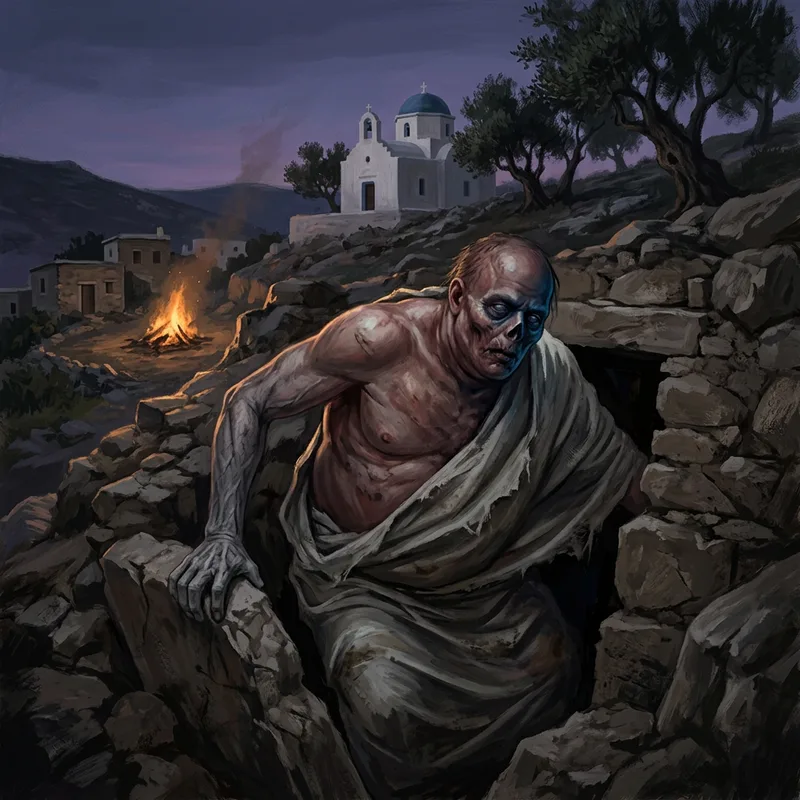
Kayit No. 039 ci 446
Vrykolakas
Ñu ngi koy wooye itam: βρυκόλακας, vourkolakas, vorvolakas, katakhanas
The vrykolakas is the Greek undead: an undecayed, bloated corpse that walks out of its grave to plague its village. Seventeenth-century churchmen and travellers described islanders exhuming and burning suspect bodies, and Tournefort's eyewitness account of such a case on Mykonos became famous across Europe. Greek and Ottoman-era graves with corpses nailed or weighted down show how old and how practical the fear was. Its contagious, door-to-door spread makes it one of the closest folkloric relatives of the modern zombie plague.12
Jëkk a bindu
1645
Described by Leo Allatius in 1645; Tournefort witnessed a 'slaying' on Mykonos in 1701Cosaan
Greek
Gërees, SiparLan moo ko waral
Ab mbugal
Greek tradition blames excommunication above all, along with grave sin, a parent's curse, burial in unconsecrated ground or an animal jumping over the corpse.Naka ngay doone benn
Dying excommunicate or cursed; anyone who answers its first knock dies within days and becomes one too.
Xel
Am na tuuti xel
Fi mu néewe doole
- cremation
- exorcism by a priest
- impaling, beheading or cutting up the corpse
- opening the grave on a Saturday, when it is at rest
- never answering a door on the first knock
Kañ la jëkk a feeñ?
 1645
1645Described by Leo Allatius in 1645; Tournefort witnessed a 'slaying' on Mykonos in 1701
notu gëstu
Li sours yi wax
Sours yi
Xibaar bu nekk ci xët wii jóge na ci sours yii, te nu bind ko ak sunu kàddu. Gis nga njuumte? Wax nu ko ci [email protected].
 Erichtho's reanimated soldier
 Philinnion
 The corpse of Thelyphron
 Vrykolakas of Mykonos
 Bouplagos
 Polykritos
 Jiangshi
 Zombi (Haitian)
 Strigoi
 Vampir (South Slavic)
 Abhartach
 Arnold Paole